Commercial Interior Design Tips to Transform Your Office Space
Why Your Office Space Speaks Before You Do
The moment a client, employee, or visitor steps into your office, they form an impression — and that impression is shaped entirely by your space. Long before a handshake or a pitch, your environment communicates professionalism, culture, and intent. Every colour on the wall, every piece of furniture, and every lighting choice sends a signal about who you are as a business. That is why investing in commercial interior design is not a cosmetic decision — it is a strategic one. Companies that treat their workspaces as passive backgrounds often find themselves losing ground to competitors whose spaces actively work in their favour.
Think of a well-designed office as you’re most silent but persuasive brand ambassador. It reassures clients that you take detail seriously. It tells prospective talent that you value the people who work for you. It reminds your existing team, every single day that they are operating in an environment built for purpose. When your space tells the right story, every conversation that happens inside it starts on stronger footing.
The Strategic Role of Space Planning in Offices
Effective office design begins not with aesthetics, but with function. Space planning is the foundation of any successful commercial interior project — it determines how people move, collaborate, focus, and feel within a given area. Poor space planning leads to bottlenecks, noise bleed between departments, inefficient storage, and a general sense of clutter that drains energy. Smart planning, on the other hand, transforms even a modest square footage into an environment that feels expansive, logical, and easy to navigate.
A well-planned office layout considers the nature of the work being done. Creative agencies may benefit from open-plan arrangements that encourage cross-pollination of ideas. Law firms and financial consultancies often require quieter, more segmented spaces that support confidentiality and focused thinking. Healthcare and wellness businesses need layouts that balance reception flow, privacy, and accessibility. There is no single formula that works across industries — which is precisely why experienced interior designers begin every project with a thorough analysis of how the business actually operates, not just how the floor plan looks on paper.
Zoning is a critical component of space planning. Dividing the office into clear functional zones — focused work areas, collaborative zones, breakout lounges, meeting rooms, and reception — gives employees a mental map of where to go depending on what they need to do. This reduces friction, supports autonomy, and creates a sense of order that improves daily performance without any micromanagement.
Branding Through Interior Design: More than Colour Palettes
Your office is a three-dimensional extension of your brand identity. When done right, walking into your workspace should feel like opening your website or reading your company brochure — familiar, intentional, and reflective of your values. Branding in interior design goes far beyond slapping a logo on a wall. It permeates the material choices, the spatial rhythm, the furniture silhouettes, and the ambient details that collectively define the atmosphere of a space.
Consider a technology startup that prides itself on agility and innovation. Its office should reflect that — with modular furniture that can be rearranged, writable wall surfaces for spontaneous ideation, bold accent colours, and dynamic lighting that shifts throughout the day. Contrast that with a luxury financial services firm, where the design language should lean toward warmth, solidity, and understated elegance — think rich timber finishes, curated artwork, and refined lighting that conveys confidence and discretion.
The process of translating brand values into spatial design requires designers to deeply understand a client’s mission, target audience, and competitive positioning. Mood boards, material samples, 3D renders, and concept statements are tools that help bridge the gap between a brand’s identity on paper and how it manifests in physical space. When this translation is executed well, the result is an environment that feels authentic — one that clients immediately trust and employees genuinely enjoy being part of.
Lighting Design: The Element That Changes Everything
Lighting is consistently underestimated in office design — and yet it is the single element most capable of transforming how a space looks and how people feel within it. Poor lighting contributes to eye strain, fatigue, and reduced focus. Great lighting, by contrast, energises a space, defines zones, highlights architectural details, and sets the emotional tone for every room it touches.
There are three primary layers of lighting that every well-designed commercial interior should incorporate. Ambient lighting provides the overall illumination of a room — the baseline from which everything else is built. Task lighting focuses light where precision work happens: desks, meeting table surfaces, reception counters. Accent lighting creates visual interest and hierarchy, drawing attention to branded installations, artwork, or architectural features that deserve to be noticed.
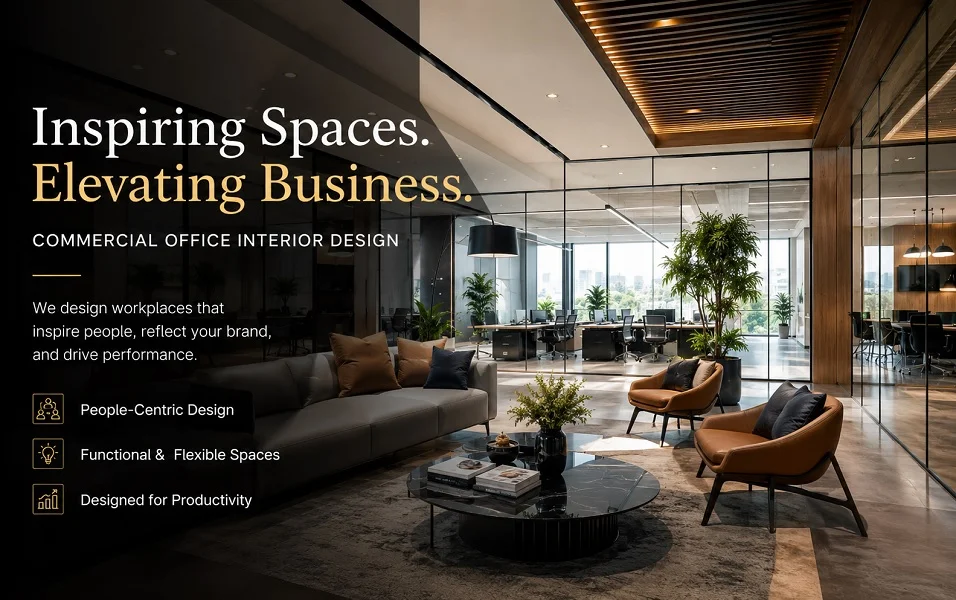
Natural light should be maximised wherever possible. Research consistently shows that access to daylight improves mood, alertness, and overall wellbeing in the workplace. Smart space planning that positions workstations near windows, uses glass partitions to allow light to travel deeper into a floor plate, and selects light-reflective materials can significantly reduce dependence on artificial lighting while improving the quality of the environment. When artificial lighting is necessary, the choice of colour temperature matters — warmer tones create a welcoming, relaxed feel ideal for reception and lounge areas, while cooler tones support concentration in focused work zones.
Materials, Finishes, and the Art of Sensory Detail
One of the most tactile aspects of commercial interior design is the selection of materials and finishes. These choices determine not only how a space looks but how it sounds, how it feels underfoot, and how it ages over time. In a commercial context, durability is as important as beauty — surfaces must withstand high footfall, frequent cleaning, and years of daily use without losing their visual integrity.
Flooring choices set the tone for an entire space. Polished concrete communicates raw industrial modernity. Engineered timber introduces warmth and natural character. Large-format porcelain tiles bring a clean, seamless precision ideal for reception lobbies and boardrooms. Each material carries its own acoustic properties too — hard surfaces amplify sound and energy, while carpet tiles and soft furnishings absorb noise and create a sense of calm.
Wall treatments, joinery finishes, soft furnishings, and ceiling design all contribute to the layered sensory experience of a well-designed office. The most successful commercial interiors are those where every material has been chosen with intention — not just for how it looks in isolation, but for how it interacts with adjacent materials, the lighting conditions of the room, and the overall character being created. This level of craft is what separates a thoughtfully designed workspace from a space that was simply furnished.
Biophilic Design and the Human Need for Nature
One of the most compelling and research-backed trends reshaping office environments today is biophilic design — the intentional integration of natural elements into the built environment. Rooted in the understanding that human beings have an innate connection to the natural world, biophilic design brings living walls, natural timber, stone surfaces, indoor planting, water features, and views of the outdoors into office spaces to support health, creativity, and emotional wellbeing.
The benefits of biophilic office design are well-documented. Employees who work in environments enriched with natural elements report lower stress levels, higher levels of engagement, and greater overall satisfaction with their workplace. Plants improve air quality. Natural textures reduce visual fatigue. Access to views of greenery has been linked to faster cognitive recovery during breaks. For businesses investing in talent retention and performance, biophilic design is not a luxury — it is a competitive advantage.
Incorporating biophilic elements does not require a complete office overhaul. Strategic placement of indoor plants, the introduction of natural material finishes, the use of earthy colour palettes, and the maximisation of natural light can create meaningful biophilic impact within modest budgets. The key is intentionality — each element should feel like it belongs to the overall design language, not like an afterthought placed to meet a trend brief.
How to Choose the Right Commercial Interior Designer
Selecting the right design partner is as important as the design itself. The process of transforming a commercial office space involves significant investment of time, budget, and trust — and the outcome is one that your team and your clients will live with for years. Choosing a designer or studio with the right experience, communication style, and creative sensibility makes the difference between a space that truly serves your business and one that falls short of its potential.
Look for a designer who takes the time to understand your business before proposing solutions. The best commercial interior designers ask questions about your workflow, your team culture, your client-facing needs, and your brand values before they sketch a single concept. They approach the brief with curiosity and rigour, not a pre-loaded template. Portfolio depth matters too — look for demonstrated experience across relevant space types and the ability to show you a variety of design languages, which signals genuine creative range rather than a single house style.
Transparency around process and pricing is non-negotiable. A professional design partner will clearly outline project phases, deliverables, timelines, and fee structures from the outset. They will manage contractor relationships, navigate regulatory requirements, and keep the project on track through to completion. The right designer does not just hand over beautiful drawings — they see the project through, ensuring that the vision translates faithfully from concept renders to the lived experience of the finished space.
Investing in Space Is Investing in Your Business
The decision to professionally design your commercial office is one of the highest-return investments a business can make. A space that functions brilliantly, looks outstanding, and feels aligned with your brand does far more than impress visitors — it shapes daily behaviour, reinforces company culture, and communicates your standards without a single word being spoken.
Well-executed commercial interior design reduces employee friction, shortens the time clients need to trust you, and creates a physical environment that people genuinely want to show up to. In a world where hybrid working has made the office a destination rather than an obligation, the quality of your workspace has never mattered more. Businesses that prioritise thoughtful, purposeful interior design are not spending on aesthetics — they are building an asset that compounds in value every time someone walks through the door.