Tips for Making Cultural Training More Practical
Cultural training is most effective when people can see how it applies to their everyday work. For large organisations, government agencies and education providers, the goal should not be to complete a session and move on. Practical training should help staff make better decisions, communicate with greater awareness, and support Aboriginal and Torres Strait Islander inclusion in ways that are respectful, consistent and relevant to their roles.
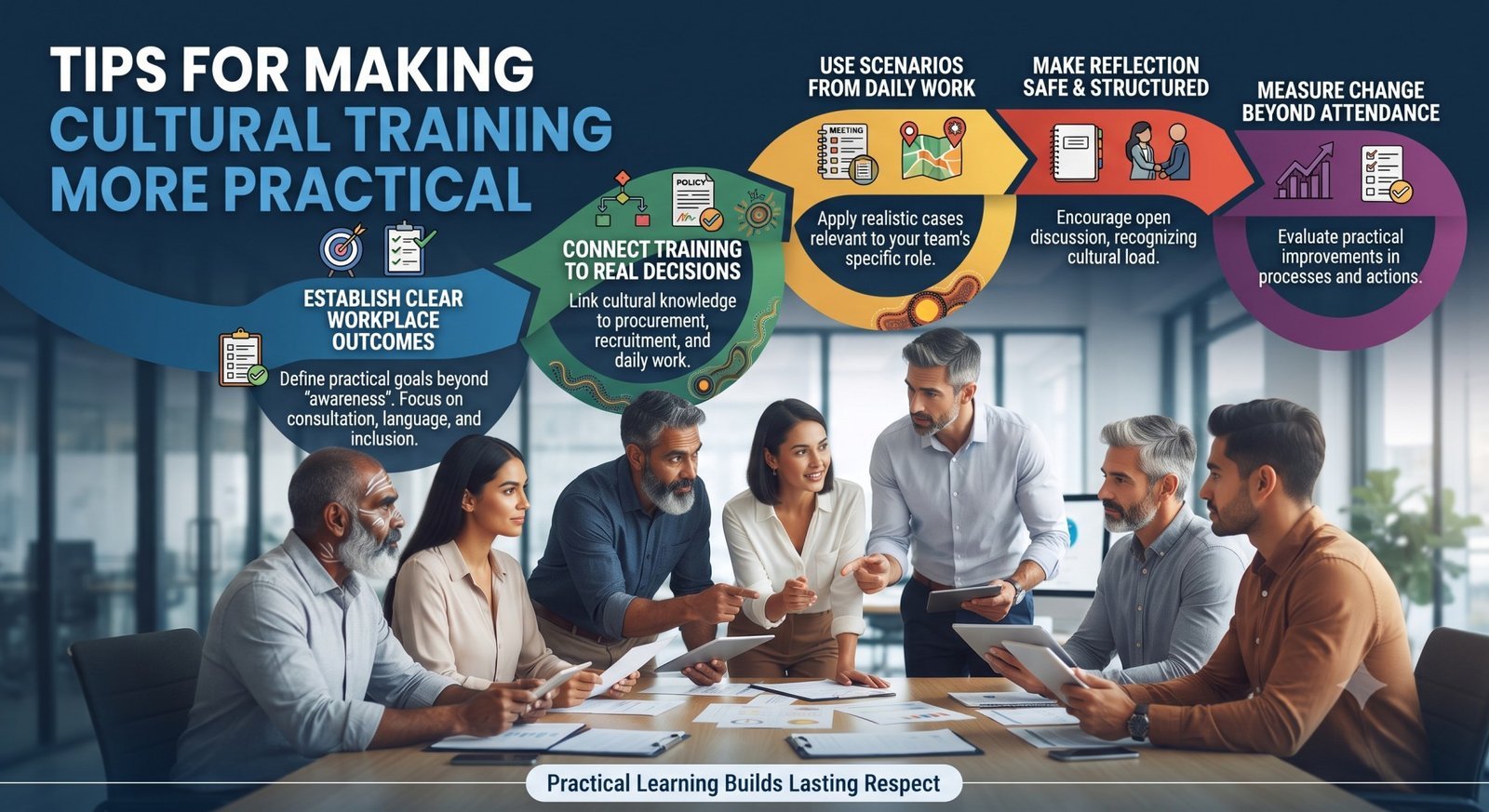
Establish Clear Workplace Outcomes
Before choosing content, facilitators should define what participants need to do differently after the training. A broad goal such as “build awareness” can be useful, but it is not enough on its own. Stronger outcomes might include improving consultation practices, reviewing internal language, reducing assumptions in service delivery, or understanding how a Reconciliation Action Plan connects to daily responsibilities.
Teams considering cultural competency training Aboriginal communities and perspectives should look for approaches that connect learning to practical workplace situations. Training works better when participants can link cultural knowledge to procurement, recruitment, stakeholder engagement, policy writing, teaching, design, leadership or customer service.
Connect Training To Real Decisions
Cultural training becomes more practical when it is tied to decisions people already make. A policy team may need to understand how consultation affects programme design. A communications team may need to review wording, imagery and permissions. A leadership team may need to consider how inclusion is reflected in governance, reporting and accountability.
Workplace examples help participants move beyond general statements of respect. They show how cultural safety can influence meeting design, complaint handling, community engagement and internal processes. Clear examples also make the learning less abstract for staff who may not immediately see how cultural awareness relates to their role.
Use Scenarios From Daily Work
Generic scenarios often feel distant from the pressures staff face. Practical training should use realistic cases that reflect the organisation’s work, audience and level of responsibility. In a university, that might involve student support, curriculum design or research ethics. In a government agency, it might involve public consultation, service access or regional engagement.
Scenarios should invite participants to examine choices, not simply identify the “right” answer. A useful exercise might ask how a team should prepare before engaging Aboriginal stakeholders, what information should be shared in advance, and how feedback should influence the final decision. Co-design becomes more meaningful when people understand the time, trust and shared authority it requires.
Make Reflection Safe And Structured
Cultural training can raise uncertainty, discomfort or defensiveness, especially when participants are asked to examine bias, privilege or institutional history. Practical programmes do not avoid these topics, but they handle them with care. A structured environment gives people room to ask questions while keeping the focus on respect, responsibility and learning.
Good facilitators create psychological safety without lowering standards. Participants should be encouraged to reflect on assumptions, but not to shift the emotional burden onto Aboriginal colleagues or community members. Recognising cultural load is important, particularly in workplaces where Aboriginal staff are often expected to explain, correct or represent complex issues beyond their formal roles.
Measure Change Beyond Attendance
Attendance numbers can show participation, but they do not prove that training changed behaviour. Organisations should consider what practical improvement looks like after the session. Managers might review whether teams are using better consultation processes, whether RAP actions are being implemented, or whether staff are applying inclusive practices in project planning.
Measurement does not need to be complicated. Short follow-up surveys, manager check-ins, revised templates and project reviews can all show whether learning has moved into practice. Reflective practice is especially useful because it encourages staff to keep asking what worked, what was missed and what should change next time.
Keep Learning Active After The Session
One-off training can create awareness, but lasting change needs reinforcement. Staff should have access to practical resources, discussion prompts, internal guidelines and opportunities to revisit key ideas. Leaders also need to model the expected behaviour, because cultural capability is weakened when training messages are not reflected in organisational decisions.
Ongoing learning may include refresher sessions, project debriefs, community-informed resource reviews or team discussions connected to RAP milestones. Over time, cultural training should become part of how the organisation plans, communicates and evaluates its work, rather than a separate activity completed once a year.
Practical Learning Builds Lasting Respect
Cultural training becomes more useful when it is specific, role-based and connected to real decisions. Clear outcomes, workplace scenarios, structured reflection and follow-up all help staff turn awareness into action. When organisations treat cultural learning as an ongoing capability rather than a compliance exercise, they are better placed to build respectful relationships and support meaningful Aboriginal and Torres Strait Islander inclusion.