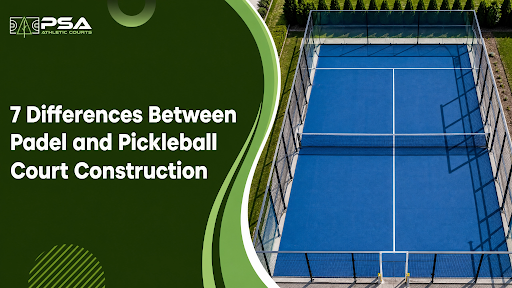
7 Differences Between Padel and Pickleball Court Construction
As racket sports continue to grow in popularity, many sports clubs, schools, municipalities, and homeowners are deciding between building a padel or pickleball court. While both sports are enjoyable and relatively easy to learn, their construction requirements differ significantly. Understanding the differences between Padel vs pickleball helps property owners choose the right facility for their space, budget, and intended use.
From court dimensions to surfacing materials and structural requirements, every aspect of a padel court vs pickleball court influences performance, maintenance, and long-term durability. Here are seven major differences you should consider before starting construction.
1. Court Dimensions
One of the biggest differences in Padel vs pickleball is the court size.
A standard padel court measures 20 meters × 10 meters (65.6 ft × 32.8 ft), while a standard pickleball court measures 44 feet × 20 feet (13.4 m × 6.1 m).
Because padel courts are significantly larger, they require more construction materials, additional site preparation, and greater installation space.
Key Difference:
-
Padel Court: 20 m × 10 m
-
Pickleball Court: 13.4 m × 6.1 m
2. Court Enclosure
Perhaps the most recognizable distinction in a padel court vs pickleball court is the enclosure.
A padel court is fully enclosed with tempered glass walls and galvanized steel mesh fencing, allowing players to use the walls during gameplay. These structural elements are essential to the sport and require specialized engineering during construction.
Pickleball courts, on the other hand, are open playing areas. While perimeter fencing is often installed for safety and ball containment, it is not part of the game itself.
3. Playing Surface
The surface materials used in Padel vs pickleball construction also differ.
A padel court typically features artificial turf filled with silica sand, providing excellent traction and controlled ball bounce. This surface is specifically designed to support the fast-paced nature of padel.
Pickleball courts are commonly built with asphalt or concrete bases finished with acrylic sports coatings. These hard surfaces deliver consistent bounce and require relatively simple maintenance.
Choosing the appropriate surface is essential for player safety and long-term durability.
4. Structural Construction Requirements
Building a padel court is more structurally complex than constructing a pickleball court.
Padel installation requires:
-
Reinforced concrete foundations
-
Tempered glass panels
-
Steel support structures
-
Specialized anchoring systems
Precision alignment
A pickleball court generally requires:
-
Site preparation
-
Concrete or asphalt base
-
Acrylic sports surfacing
-
Net system
-
Optional perimeter fencing
Because of these additional structural components, padel construction usually involves more specialized contractors.
5. Installation Cost
When comparing Padel vs pickleball, construction costs vary considerably.
A padel court typically has a higher upfront investment due to the glass walls, steel framework, artificial turf, and specialized installation process.
Pickleball courts are generally more affordable because they use fewer structural materials and have a simpler construction process.
Although costs vary depending on location and site conditions, pickleball is often the lower-cost option for public parks and residential projects.
6. Maintenance Requirements
Maintenance differs based on the court surface and structural components.
A padel court requires:
-
Artificial turf grooming
-
Silica sand redistribution
-
Glass cleaning
-
Structural inspections
-
Fence maintenance
Pickleball courts typically require:
-
Surface cleaning
-
Crack repairs
-
Acrylic resurfacing every few years
-
Line repainting
-
Drainage inspections
Both court types benefit from routine maintenance, but padel facilities generally require more specialized care.
7. Space and Facility Planning
Before choosing between a padel court vs pickleball court, consider your available space.
A padel court requires additional clearance around the enclosure for maintenance access and safe player movement. Before finalizing your layout, learn how big is a padel court to ensure adequate space for safety, accessibility, and future maintenance. Lighting, spectator areas, and fencing should also be considered during the planning stage.
Pickleball courts offer greater flexibility and can often be installed as standalone courts or incorporated into multi-sport facilities with shared spaces.
For parks, schools, and community recreation centers, pickleball may accommodate more courts within the same footprint.
Which Court Is Right for Your Project?
Choosing between Padel vs pickleball depends on several factors:
A Padel Court May Be the Better Choice If You Want:
-
A premium racket sport facility
-
Tournament-quality construction
-
An enclosed playing experience
-
A unique recreational attraction
-
Long-term commercial or club investment
A Pickleball Court May Be Better If You Need:
-
Lower construction costs
-
Faster installation
-
Flexible recreational use
-
Multiple courts in limited space
-
Simple maintenance
Carefully evaluating your goals, budget, and available land will help determine the best option for your facility.
Final Thoughts
Understanding the differences between Padel vs pickleball is essential before investing in a new sports facility. While both sports continue to grow in popularity, the construction process for a padel court vs pickleball court differs significantly in terms of size, materials, structural complexity, maintenance, and cost.
Whether you’re building a community recreation center, sports club, or private facility, choosing the right court type will ensure a better return on investment and provide players with a safe, durable, and enjoyable playing experience for years to come.