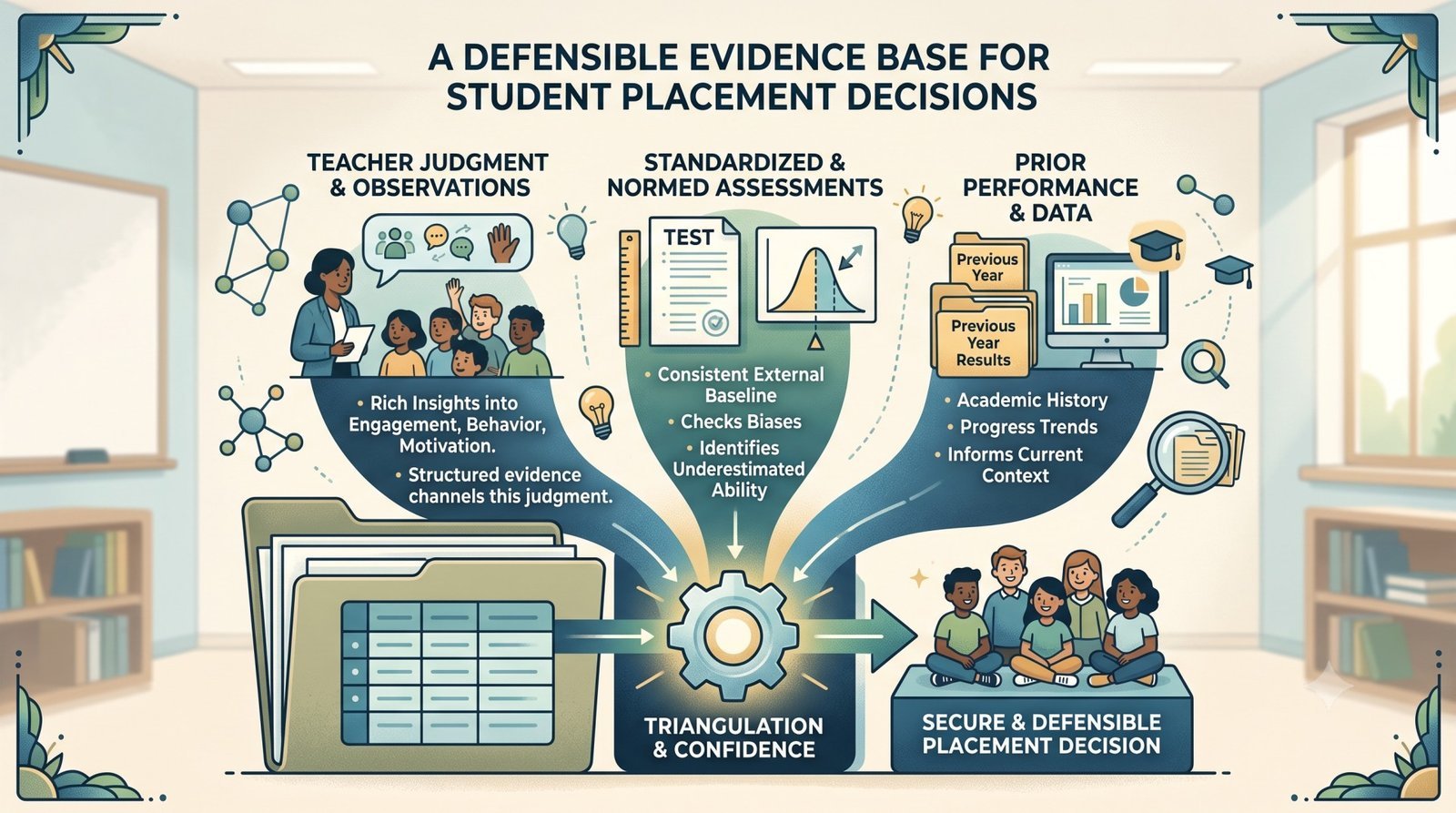
The Evidence Base That Makes Placement Decisions Hold
Ask most school leaders what goes into a placement decision and you will get a reasonable answer. Assessment results, teacher observations, prior performance, and sometimes a conversation with the student’s previous year teacher. It sounds like a process. What makes it more than a process, and what makes it genuinely defensible, is the quality and completeness of the information feeding it. The schools that get this right have moved from a collection of impressions to a structured evidence base, and the difference shows up in the decisions they are able to make with confidence.
The Role of Teacher Judgment, and What It Works Best Alongside
Teachers are not poor judges of their students. The research on this is more nuanced than the headline version suggests. A 2024 study in Frontiers in Psychology titled Where Experience Makes a Difference, conducted by researchers at the Technical University of Munich, found that experienced teachers draw on a significantly broader spectrum of cues when reading students, connecting surface behaviours like hand raising to deeper motivational signals like confidence and interest. That capacity for richer, more connected observation is real, and it matters.
But professional vision has a documented limitation: it is shaped by what is visible in a particular classroom, with a particular student, over a particular period of time. A student who is quiet, cooperative, and academically middle of the road is easy to misread. A student whose home language differs from the classroom, or whose socioeconomic background differs from the school’s typical profile, is at particular risk of being underestimated. Research conducted across England, Germany, and the United States has found that teachers at the start of primary school systematically underrated students with less educated parents and overrated those whose parents held university degrees, independent of the students’ actual performance on standardised tests. The pattern was not the result of poor professional judgment. It was the result of good professional judgment operating on incomplete information.
That distinction is important. The answer is not to distrust teachers. It is to give them a more complete picture.
What Consistent, Normed Assessment Adds to the Process
A 2025 study titled Rigidity of Class Ability Grouping Practices in Australia, published in the British Journal of Educational Research and led by researchers at Edith Cowan University, found that Australian schools make grouping decisions primarily on the basis of educators’ perceptions of student and cohort needs, with those perceptions shaped by a locally determined mix of assessment data and classroom experience. There was no consistent external baseline driving the process. The weight given to any particular piece of information varies considerably from school to school, and sometimes from year to year within the same school.
That variability is where the risk sits. When the basis for placement shifts without a stable external reference point, the decision becomes difficult to review and even more difficult to defend if it turns out to be wrong. A school placement exam that is normed, curriculum aligned, and independently marked gives educators something that professional instinct alone cannot provide: a baseline that sits outside the relationship between a student and their previous teacher. It does not replace the teacher’s knowledge. It checks it, and fills in the parts that observation alone tends to miss.
The most useful placement processes treat the test result as one input among several, but insist that it be a standardised, independently marked one. Combined with NAPLAN data and prior year results, that kind of baseline makes it possible to distinguish between a student who is genuinely operating at a certain level and one who has been assessed under circumstances that undersell them, a disrupted term, a difficult transition year, or a tool designed for a different cohort profile.
The Question Worth Asking Before Every Placement
There is a specific question that well structured placement processes build in, and its presence or absence explains a great deal. The question is not simply where is this student now. Most assessments answer that adequately. The question is: how confident are we that this placement reflects the student’s actual ability, rather than the conditions under which we assessed them?
A student placed on the basis of a single, unverified data point enters a class designed around a certain expectation and begins to perform accordingly. Research into the effects of ability grouping has consistently found that students placed in lower streams tend to receive less challenging instruction and develop lower academic expectations of themselves over time. The placement shapes the outcome, which then appears to confirm the placement. The feedback loop is quiet, slow, and difficult to interrupt once it is established.
Structured, normed assessment breaks that loop before it starts. When the initial placement decision rests on an evidence base that is broad enough to catch the student who has been undersold by circumstances, the downstream consequences of a poor placement become far less likely to occur.
What a More Complete Picture Makes Possible
The shift that makes a genuine difference is not from judgment to testing. It is from one data point to a more complete picture. An independently administered, curriculum aligned placement assessment gives educators the ability to triangulate: to set what they know about a student from observation and prior experience against what a standardised instrument, applied consistently across the cohort, reveals about where that student actually sits.
That triangulation is most valuable for the students who are hardest to read. The quiet achiever who does not raise their hand. The student whose performance dipped during a disrupted period and has not yet recovered their visible confidence. The student whose home environment differs enough from the school’s typical profile that the usual cues do not apply. For each of these students, a normed placement assessment is not a bureaucratic hurdle. It is the mechanism by which their actual ability enters the record.
The Decision That Gets Made Once
Placement is one of those school decisions that feels administrative until you consider what follows from it. The class a student enters shapes the pace of instruction they receive, the peers they work alongside, and the expectations quietly communicated to them about what they are capable of. None of that is irreversible, but in practice, few students move significantly between groups once placed.
That is why the basis for the decision deserves more scrutiny than it typically receives, and why the schools that approach it most carefully tend to be the ones that treat it not as a formality to be completed before the year begins, but as a question worth answering rigorously every time. The information available at the point of placement either supports that rigour or it does not. A structured, independently administered assessment is the most straightforward way to ensure it does.